How to Keep Cabinet Jobs Organized
By Cabinetshop Maestro • Updated 2026-08-01
Keep cabinet jobs organized by putting every job in one place, giving each job the same stages from quote to install, and making that record the only place anyone looks for a status. Most shops don't lose jobs in the shop — they lose them in the gaps. A change order that lived in a text message. A delivery date nobody wrote down. A deposit that never got logged. Pick one system, put the whole job in it, keep it current. The tool matters less than the habit of one record per job.
Why cabinet jobs fall apart
It's almost never the building. Shops that turn out beautiful work still run jobs out of four places at once — texts with the customer, email with the designer, plans on the bench, and half the schedule in the owner's head. Nothing is wrong until two jobs need the same week, and then everything is.
Put every job in one place
One record per job, opened the day you quote it and closed the day the punch list is done. Quote, deposit, drawings, change orders, materials, delivery date, install date, final invoice. If a piece of the job lives somewhere else, that's the piece you'll lose.
Give every job the same stages
Same path, every job, so anyone can see where a job sits without asking. Sales carries it first: Initial. Estimates and proposals. Drawings and revisions. Then production takes over: Schedule. Build. Finish. Install. Punchlist. Eight stages covers most shops. Fewer is fine. What matters is that they don't change job to job.

Milestones in Cabinetshop Maestro, split into a sales workflow and a production workflow. You set the stages to match how your shop works, then every job runs the same path.
Keep the paperwork on the job, not in your inbox
Change orders are where the money leaks. Write it on the job the day it happens, with the price, and get the customer to confirm in writing. Same with deposits and POs. Photos too — a picture of the install goes further than a paragraph when a customer calls six months later.
Let the schedule come from the jobs
A whiteboard is accurate the day you write it. Build the schedule off the job records instead, so when a delivery slips the schedule already knows. One calendar the whole shop reads.
The ten minute weekly check
Once a week, walk the list top to bottom. Anything that hasn't moved a stage in two weeks gets a reason or a phone call. That's the whole review. It's short because the record is already current.
How this gets you out of the bottleneck
Most owners are the bottleneck because they're the only one holding the full picture. Every question routes through them. Once the job record is complete and current, your lead can answer his own question, your installer can see his own week, and you stop being the lookup service for your own shop.
Where software fits
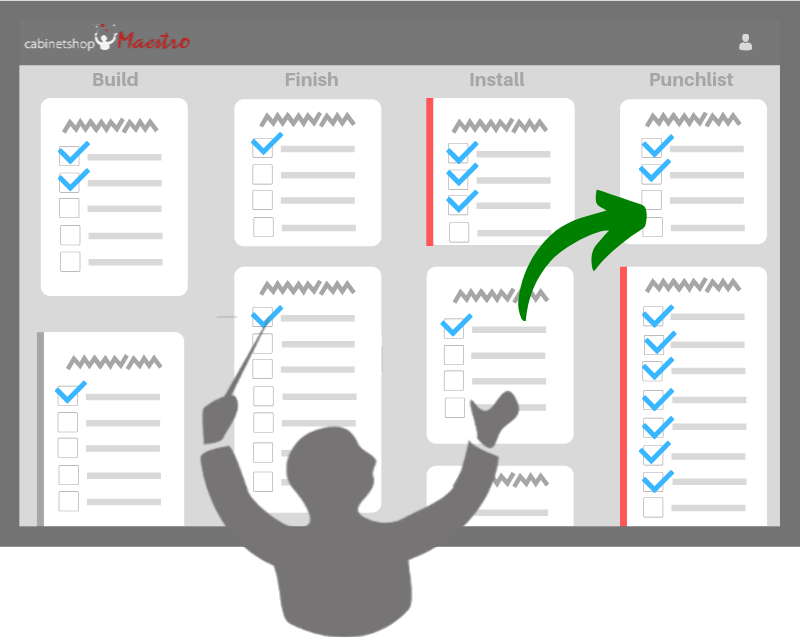
You can run this on paper. Plenty of shops do, up to a point. It breaks somewhere around a dozen jobs at once, when keeping the paper current costs more than the paper saves. That's the point to move it into something built for it — Cabinetshop Maestro puts the quote, the change orders, the schedule, and the install on one job record, so the system above runs itself instead of running on your memory. The workflow board shows where every job sits at a glance, and the digital job folder keeps the drawings, change orders, and photos on the job itself.

One job record: details, drawings, discussions, client updates, and the milestone timeline, all in one place.
Frequently Asked Questions
How do I keep cabinet jobs organized from quote to install?
Open one record when you quote, and keep everything on it — deposit, drawings, change orders, materials, delivery, install, final invoice. Move the job through the same set of stages every time so anyone can see where it stands without asking you.
How do cabinet shops keep the team aligned on job status?
One shared record per job that everyone reads, and one schedule built from those records. Alignment breaks when the lead, the installer, and the owner are each looking at a different source.
How do I stop being the bottleneck in my own cabinet shop?
The bottleneck is usually information, not work. If you're the only one who knows where a job stands, every question comes to you. Put the full picture where the crew can see it and most of those questions stop.
What's the simplest way to track a cabinet job?
A single list of open jobs, each with a stage and a next date. Start there. Add detail once the list is reliable — a system nobody updates is worse than a whiteboard.
Try Cabinetshop Maestro® Today!
Nothing to download, nothing to install, and no contracts.